
Route Planning for a 200-Kilometer-Long High-Voltage Direct Current Cable
Pathfinder for SuedOstLink+
The transmission system operator 50Hertz is building SuedOstLink+, a high-capacity power line that will transport direct-current electricity from near Schwerin to Wolmirstedt, just under 20 kilometers north of Magdeburg. The best route for the new power line is currently being determined with Fichtner’s support. Among other things, our tasks include the planning coordination, the complete routing, the planning of underground construction, and the preparation of documentation for permit applications.

200 Kilometers of High-Voltage Direct Current Transmission
The energy transition is not only increasing Germany’s capacity to generate green electricity, but is also transforming its power grids (see Network Development Plan). New transmission lines are planned to bring wind power from the north to consumers in southern Germany. Some of these are designed as high-voltage direct current (HVDC) transmission systems (see also text box below). Among these new HVDC lines is SuedOstLink+, a project by transmission system operator 50Hertz.
Starting in 2032, SuedOstLink+ is expected to transmit up to 2,000 megawatts of electrical power from a connection point west of Schwerin to the Börde district near Magdeburg. There, the approximately 200-kilometer-long route will connect to the SuedOstLink transmission line, which will continue on to Bavaria.
Many Factors Involved and Some Conflicting Goals
When planning an HVDC transmission line like SuedOstLink+, there are many factors to consider:
- Technical and economic factors
- Interests of landowners
- Nature and species conservation as well as protected areas
- Agricultural and forestry interests
- Geological challenges
- Waterways, lakes, and groundwater
- Buildings and structures (above and below ground)
- Transportation infrastructure such as railroad tracks and roads
- Electricity pylons as well as water, district heating, and gas pipelines
- Possible archaeological finds and unexploded ordnance
- Construction sites and roads temporarily required for the project
- …
Given the multitude of factors involved, it can be challenging to fully integrate all requirements and interests. However, this complexity presents an opportunity to develop creative and innovative solutions that will advance the entire project. By taking a holistic view of the project and carefully analyzing the interdependencies, it is possible to achieve a balanced outcome that reconciles the various interests.
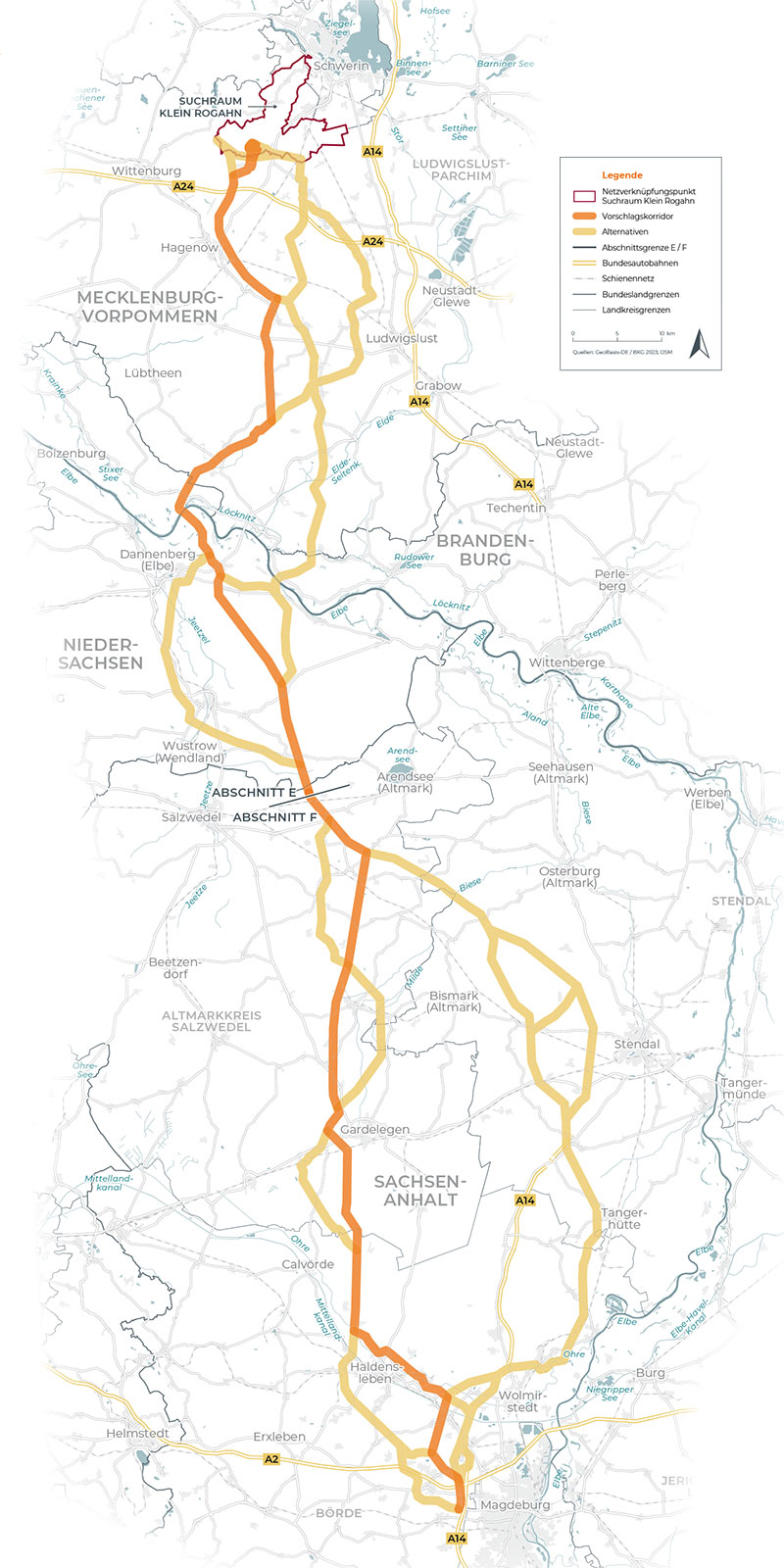
As part of the federal sectoral planning process, several potential corridors were identified for SuedOstLink+ and a preferred corridor was defined. Detailed route planning is being carried out for the corridor defined by the German Federal Network Agency.
(Picture source: 50Hertz Transmission, GeoBasis-DE / BKG 2023)
Preliminary Through to Detailed Planning
The overall picture is initially a rough one because a federal sectoral planning process must be completed prior to planning approval and detailed route planning. The applications propose corridors 1,000 meters wide within which the power line could later be routed. The process of identifying potential corridors begins with a process of elimination, since many areas – such as protected areas – cannot be used in the first place. Laying the line in densely built-up areas, if it were even feasible, would entail rather high costs and many acceptance issues. Technical criteria also narrow down the number of possible corridors, such as the required distances from existing infrastructure or the available space for connecting the HVDC cable. There were nevertheless many potential corridors for SuedOstLink+. In the summer of 2024, 50Hertz submitted its corridor proposals for SuedOstLink+ to the Federal Network Agency and defined a preferred option, known as the “preferred corridor”. The Federal Network Agency confirmed that preferred corridor in June 2025.
Searching for the Optimal Route
Later that same month, 50Hertz submitted a proposal to the Federal Network Agency describing the preliminary route within the corridor. Detailed planning is based on the preliminary route. Finding the optimal route is a complex challenge that requires a great deal of expertise and personnel resources. 50Hertz therefore brought in Fichtner’s “Linear Infrastructure” planning team and the engineering firm Inros Lackner SE to assist with route planning. The contracted services include:
- planning of underground construction
- area planning (e.g. construction sites and access roads)
- 2D and 3D cable planning
- preparation of plans
- communication with public agencies
- supervision of ground investigation
- data inquiries (third-party lines, unexploded ordnance, etc.)
- project GIS and web GIS support.
Since the planning approval process is scheduled to be completed in 2027 and construction is set to begin in 2028, work on route planning began back in the autumn of 2023 – well before the Federal Network Agency confirmed the preferred corridor. For example, the initial ground investigations have already taken place. During these investigations, the ground is explored to a depth of up to four meters approximately every 100 meters. When cables are laid using the trenchless method rather than by digging a trench, the ground is actually explored to a depth of up to 40 meters. This is necessary, for example, when the line needs to cross underneath a high-speed rail line or a river.
Fewer Losses with High-Voltage Direct Current Transmission
High-voltage direct current (HVDC) transmission carries large amounts of electrical power over long distances with fewer losses than a 220 or 380-kilovolt (kV) alternating current (AC) line. For this reason, a number of the new north-south connections are being built as 525-kV HVDC lines. At the ends of the lines, converter stations convert alternating current to direct current and vice versa.
In general, HVDC transmission lines – similar to AC transmission lines – can be constructed as overhead lines (on pylons) or as underground cables. To minimize the impact of the new power lines on the landscape, priority is given to underground cables for HVDC connections within Germany. HVDC overhead lines should be built only if an underground line is not practical for technical, environmental, or economic reasons. For farmers, an underground HVDC cable generally does not pose any restrictions, as the cables are buried about 1.5 meters below the surface.
When planning the route for SuedOstLink+, it is necessary to take into account not only the rivers and streams that the line will cross under, but also bodies of water in forested areas and groundwater levels. In such cases, our “Linear Infrastructure” team has been able to draw on the expertise of our subsidiary Fichtner Water & Transportation. The SuedOstLink+ project has also been supported from within the Fichtner Group by our subsidiary Fichtner IT Consulting. Among other things, the IT specialists have implemented the web-based geographic information system (GIS), which enables project participants to access the current status of planning. For example, the GIS can be used to visualize the cable’s route in three dimensions.
Thanks to the highly advanced route planning, the planning approval is proceeding according to the project schedule. Construction work on SuedOstLink+ can then begin on schedule, and the first electricity can flow through the new HVDC connection in 2032.
June 2026

Niels Moritz Weber
Subproject Manager in the Linear Infrastructure Division