
Nhon Trach 3 and Nhon Trach 4 Power Plant Projects in Vietnam
Technical Consulting and Project Support from A to Z
Modern gas-fired power plants feature high flexibility and provide an effective means of complementing volatile electricity production from renewable sources. To achieve its goal of a climate-neutral electricity supply, Vietnam is therefore focusing not only on massively expanding renewable energies, but also on building such flexible gas-fired power plants. One example of this is the two power plant units Nhon Trach 3 and Nhon Trach 4, for the construction of which PetroVietnam Power Corporation places its trust in Fichtner’s support. Our team is supporting the project throughout – from preliminary design, to environmental and social impact studies, through to construction supervision and commissioning, as well as the subsequent warranty phase.

Vietnam has set itself the goal of achieving a climate-neutral electricity supply by 2050. But today, more than half of its electricity is still generated in coal-fired power plants. To make the transition to net zero efficient, renewable energies are being massively expanded. At the same time, flexible gas-fired power plants are being constructed that can respond to rapid fluctuations in the supply of wind and solar power and ensure stability of the electricity supply. These power plants include the Nhon Trach 3 and Nhon Trach 4 units, which were developed and constructed by PetroVietnam Power Corporation (PV Power). With a total investment of around 1.4 billion US dollars, both plants were successfully completed and entered commercial operation at the end of 2025.
Fuel from Liquefied Natural Gas
Nhon Trach 3 and Nhon Trach 4 are located in the Ong Keo Industrial Park in the southern province of Dong Nai, near the metropolis of Ho Chi Minh City, in the vicinity of the Nhon Trach 1 and Nhon Trach 2 units, which have been operated by the power generation company PV Power since 2009 and 2011 respectively. Both the older and newer units are combined cycle power plants, meaning that they use both gas and steam turbines to generate electricity and are fueled by natural gas, most of which comes from the PetroVietnam Gas Corporation’s LNG terminal situated around 80 kilometers away at the mouth of the Thị Vải River.
Flexible Power Plant Solutions for the Energy Transition
Combined cycle power plants use the waste heat from the gas turbine to generate steam for a downstream steam turbine, thus making particularly efficient use of the fuel. In modern single-shaft combined cycle power plants such as Nhon Trach 3 and 4, the gas turbine, generator, and steam turbine are all mounted on one shaft. This reduces space requirements and investment costs, while enabling efficiency levels of up to 62 percent.
Another important step toward climate protection is the fact that the new gas turbines can co-fire up to 50 percent hydrogen. In the future, they could therefore contribute to the decarbonization of electricity production as soon as “green” hydrogen becomes available on an industrial scale.
The First Single-Shaft Combined Cycle Power Plants in Vietnam
In terms of power plant design, the Nhon Trach 3 and 4 units have a decisive advantage over the older Nhon Trach 1 and 2 units. As modern single-shaft plants, they feature smaller space requirements, lower specific investment costs, and slightly increased plant efficiency. In this type of plant, the gas turbine, generator, and steam turbine are all mounted on one shaft, whereas the older multi-shaft plants Nhon Trach 1 and 2 have a separate shaft and generator for each gas turbine and each steam turbine.
At a very early stage of planning, Fichtner recommended a single-shaft design for Units 3 and 4, as this is the optimal way to meet current requirements. A modern single-shaft combined cycle power plant can convert around 62 percent of the energy content of natural gas into electrical energy. By comparison, the efficiency of new multi-shaft combined cycle power plants is 61 percent.
One advantage shared by all combined cycle power plants is their ability to adjust their output within a few minutes. This flexibility is particularly important for balancing out spontaneous fluctuations in electricity generation from wind and solar energy.
High-Tech Turbines for High Performance
At the heart of the power plants are GE Vernova’s latest-generation 9HA.02 gas turbines. The turbines allow for hydrogen blending of up to 50 percent, which is important in terms of climate protection goals. The two new units together produce up to 1,624 megawatts of gross electrical power and are expected to feed approximately nine million megawatt-hours of electricity into the grid each year. This is the equivalent of about one-third of Ho Chi Minh City’s annual electricity consumption.
Developed Sustainably and Responsibly
PV Power wants to ensure that the Nhon Trach 3 and Nhon Trach 4 (NT34) Project is developed in a sustainable and responsible manner, taking into account potential environmental and social impacts. For this reason, Fichtner was additionally contracted to conduct an environmental and social impact assessment in accordance with international standards, covering both the construction and operation phases. The assessment included a baseline data study, legal and regulatory aspects, identification of potential project impacts, and the preparation of an environmental and social management plan.
Optimization Through Physical Modeling
Our extensive experience from many power plant projects was incorporated early on into the review of the plant design. For example, we suggested performing physical modeling of the cooling water inlet in addition to numerical modeling. Those physical models revealed weaknesses in the design that could be remedied during the planning phase. Performing the more cost-intensive modeling in advance thus revealed a need for optimization that would otherwise only have become apparent during operation, when rectification would have incurred significantly higher costs.
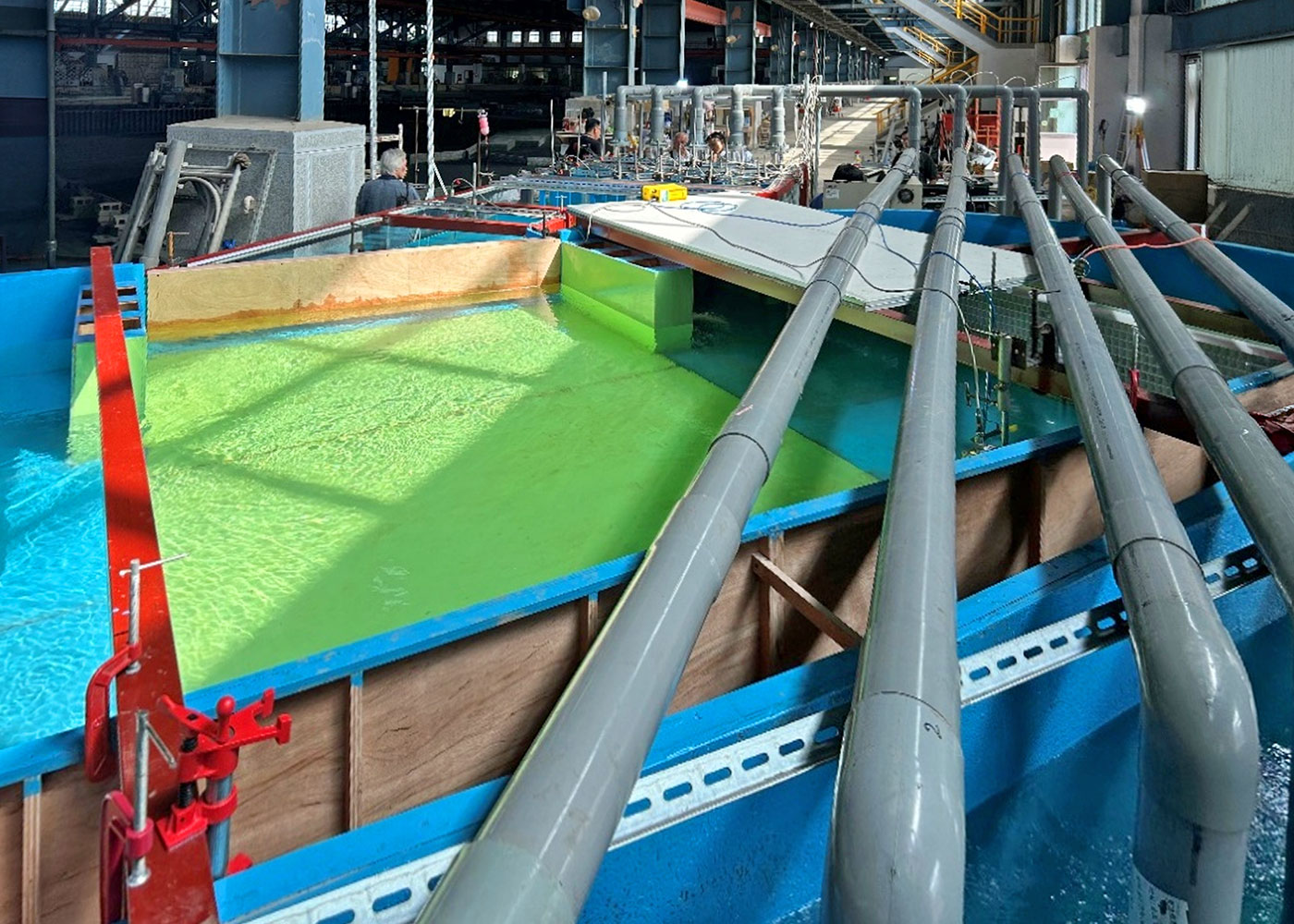
Physical modeling of the inlet at the Tainan Hydraulic Laboratory in Taiwan.
Optimization of the Power Supply for Auxiliary Systems
Another important change we proposed during the planning phase concerned the power supply for auxiliary systems shared by Units 3 and 4. Auxiliary systems in a power plant comprise technical equipment that is essential for operating the main installation, including water and air systems, hoisting and conveyor equipment, and fire protection systems.
The original design envisaged that the shared auxiliary systems would primarily be supplied with power by Unit 3, as this was the first to be built. No difficulties would arise while Unit 3 is in operation. However, if Unit 3 were to come to a standstill, for example due to maintenance work, this could cause problems with the supply from Unit 4.
This problem was uncovered by a thorough review of all electrical load flow diagrams. Based on these findings, we recommended design adjustments that were implemented during construction. As a result, the shared auxiliary systems can now be supplied with power equally by Unit 3 and Unit 4. This underscores the need for a detailed review of design drawings that takes all possible load cases into account.
Support During Construction and Commissioning
Fichtner was also involved in the construction supervision and commissioning. The construction of both units has now been completed. In spring 2025, the gas turbine at Nhon Trach 3 was successfully tested, followed shortly thereafter by successful testing of the steam turbine. Unit 3 was completed in November 2025 and has since been in operation. The Nhon Trach 4 plant was first fired up in mid-2025, was handed over to the operator on 15 December 2025, and is now in operation.
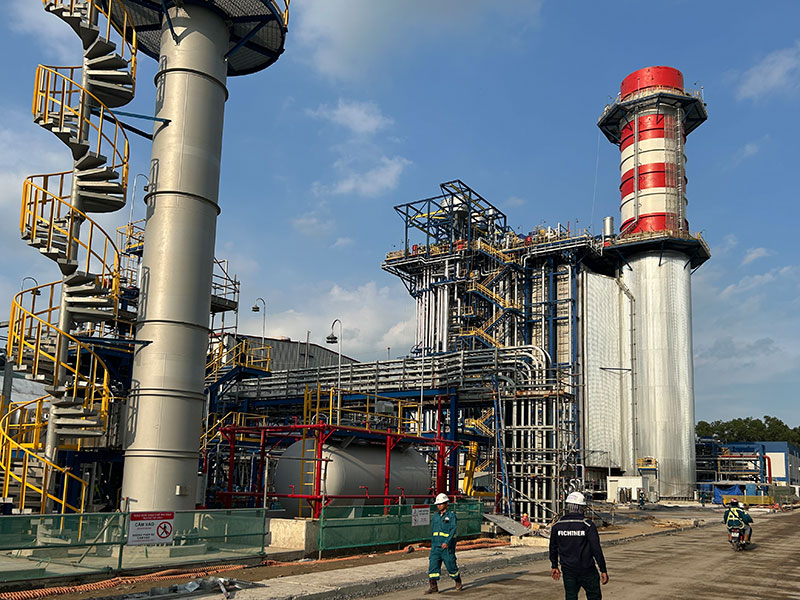

Construction of both power plant units has been completed – Nhon Trach 3 was handed over to the operator in November 2025, followed by Nhon Trach 4 in December 2025.
Support Beyond Commissioning
Our support for the project does not end with commissioning, but continues during the initial operating phase. In the event of warranty claims, the power plant operator PV Power can call on us to assess the facts and assist it with its claims against the plant manufacturer.
Fichtner has a proven track record in supporting power plant projects from the design phase through to the warranty period. Our experience and commitment in every phase of the project provide clients such as PV Power with more certainty in the success of their project.
Fichtner’s Services for the Nhon Trach 3 and 4 (NT34) Project
Since the end of 2020, Fichtner has been providing continuous support for the NT34 project, from preliminary design to the warranty phase, with the following services:
- Reviewing the plant design during the bidding phase
- Preparing technical and financial bid evaluations
- Assisting with contract negotiations and compiling contract documents
- Reviewing the service agreement and assisting with negotiations on the agreement
- Project control and schedule management
- Review of drawings for the basic and detailed design
- Conducting an environmental and social impact assessment (ESIA)
- Preparing a detailed environmental and social management plan (ESMP)
- Quality assurance and quality control management
- Supervising construction and commissioning
- Risk, safety, and environmental management
- Support during the warranty period
- Training and know-how transfer
April 2026

Max Stössel
Project Manager at the Fichtner NT34 Project Office

Dr. Matthias Johnsen
Technical Director SEA HUB in Kuala Lumpur,
Engineering Manager in the NT34 Project