FICHTNER Talks 2025
From Energy Policy Triangle to
Multidimensional Action Plan
How can the energy transition succeed – and what will it take to achieve the net-zero target by 2045? This was the central question at the FICHTNER Talks 2025. With “Topping-Out Ceremony of the Energy Transition” as their guiding theme, experts from business, science, and politics discussed priorities, challenges, and concrete courses of action. The result was a clear endorsement of a multidimensional action plan that goes beyond the traditional energy policy triangle.

CLARITY OF OBJECTIVES
Already in the opening interview, Dr. Andreas Weidler, CEO of Fichtner, and Sabine Nallinger from Stiftung Klimawirtschaft (Climate Economy Foundation) emphasized that the coming years will be pivotal. The audience understood the provocative motto of the conference as both a criticism and an incentive to actually achieve the “topping-out ceremony” of the energy transition.
Prof. Dr. Dr. h. c. Lars P. Feld did a particularly impressive job of putting the energy-economic and technological contributions into an overall economic context. Karsten Schwanke, climate researcher and weather presenter, reminded listeners that the physical reality of climate change allows for no compromises – thus emphasizing the urgency of joint action.

Karsten Schwanke,
meteorologist and
weather presenter for
German public broadcaster ‘ARD’
FROM ENERGY POLICY TRIANGLE TO ACTION POLYGON
In his summary, moderator Dr. Albrecht Reuter visualized the outcome of the conference as follows: The familiar energy policy triangle of climate protection, affordability, and energy security is giving rise to a multidimensional action polygon – a metaphor for the necessary interaction between many stakeholders and disciplines.
- Climate protection: Instead of just discussing target temperatures, the focus must now be on rapidly establishing an efficient renewable energy infrastructure.
- Affordability: If the huge initial investments required for the transformation can be mustered, energy could become cheaper and more sustainable in the long term than ever before.
- Energy security: In future, this will be more closely linked to the respective energy application – not every user group needs the same standards.
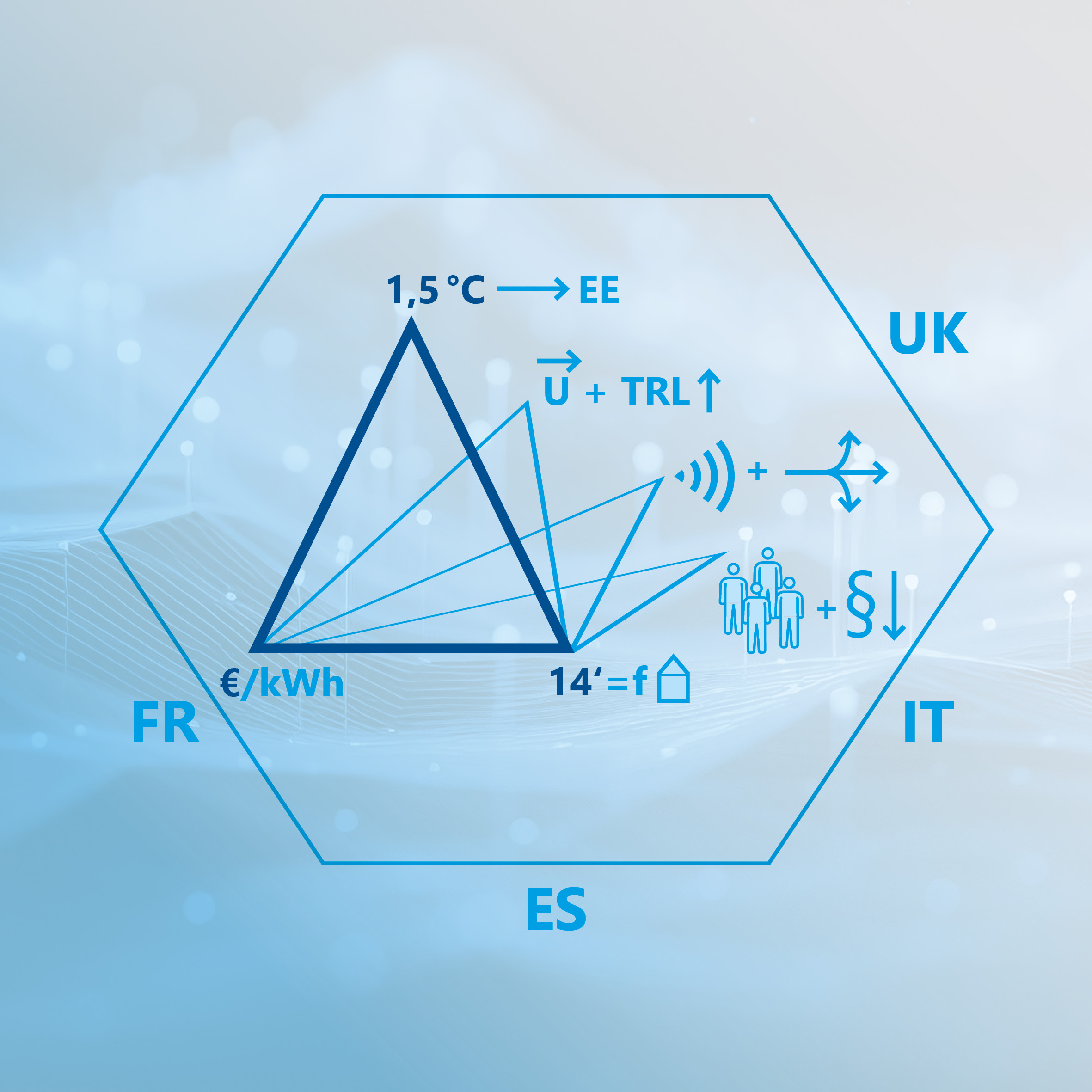
Schematic representation of the metamorphosis from energy policy triangle to action polygon:
The graphic clearly shows that the energy transition is no longer a triangle, but rather a complex interplay of many factors. To be successful, it is necessary to consider and shape climate, costs, energy security, technology, digitalization, law, organization, and international cooperation simultaneously.
NEW DIMENSIONS: IMPLEMENTATION, DIGITALIZATION, PARTICIPATION
In addition to this, the participants expanded the model to include further key areas of action:
- Speeding up implementation: The pace of innovation must increase significantly. The concept of the Technology Readiness Level (TRL) was used to highlight the importance of quickly putting new technologies into practical use.
- Digitalization and communication: Germany lags behind other countries in terms of infrastructure expansion. Digital networking and artificial intelligence can provide decisive impetus here – even if data centers themselves are energy-intensive.
However, in order for that digital infrastructure to be used effectively, there must also be clear, comprehensible, and targeted communication between all stakeholders. - Involving people and reducing regulation: The energy transition will succeed only if it is understood as a joint task. Bureaucratic hurdles must be lowered, and legal frameworks must become more reliable.
SYSTEM FOCUS
The FICHTNER Talks made it clear that it is not just about individual measures, but about the system as a whole. Future energy systems must be resilient to climate impacts and geopolitical crises – such as through decentralized, autonomous energy cells embedded in the European grid.
Roundtable with Thomas Ammon, Prof. Christian Held, Anna Jasper-Martens, Karsten Schwanke, Matthias Zartmann, Ralf Klöpfer, Michel Nicolai, and Albrecht Reuter
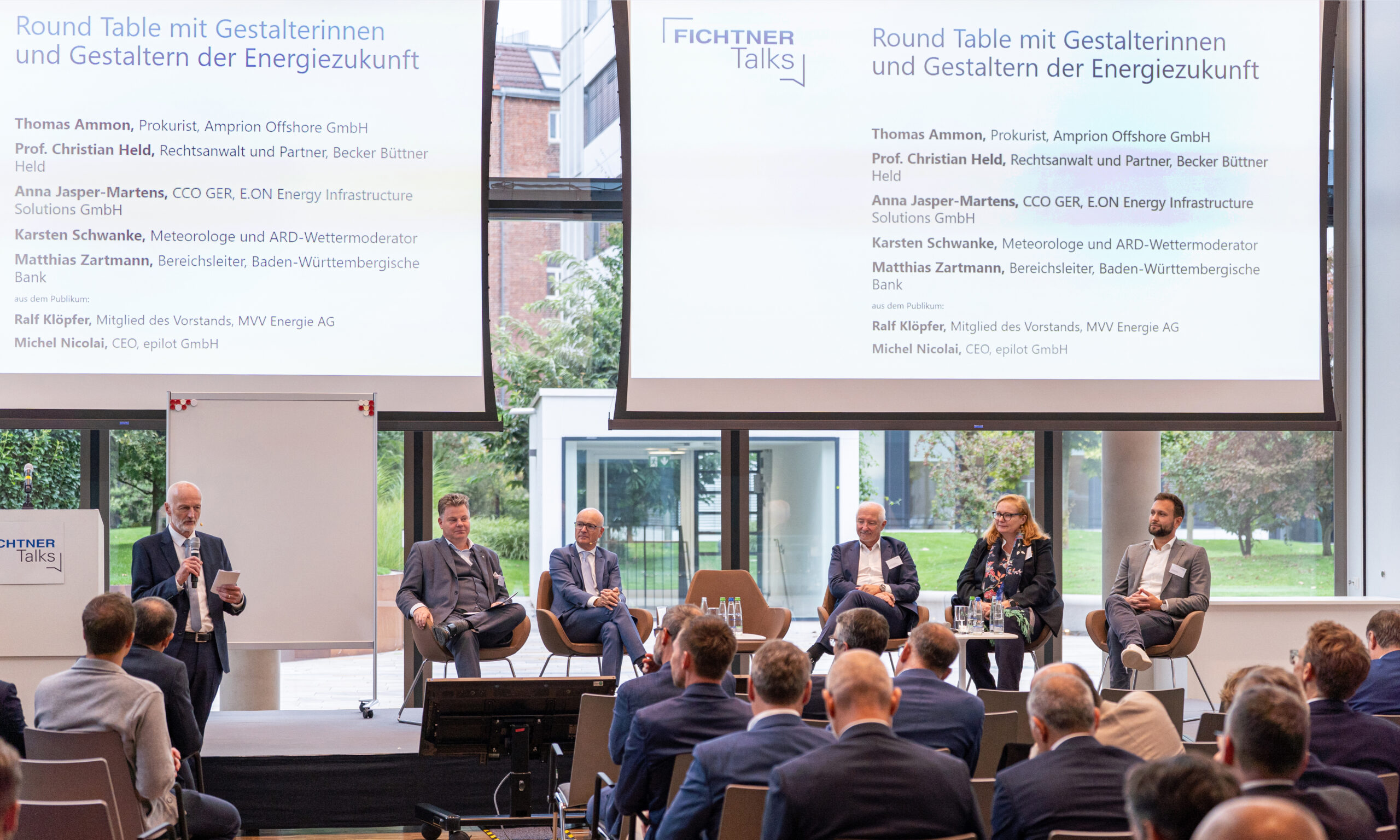
In the end, there was a shared realization: If all stakeholders contribute their expertise in a targeted manner, the “topping-out ceremony of the energy transition” can be achieved. And the next milestone has already been set: The tenth anniversary of the FICHTNER Talks will be celebrated in Stuttgart in September 2026.
October 2025
Dr. Albrecht Reuter
Scientific Director of the FICHTNER Talks
Managing Director of Fichtner IT Consulting GmbH