
User-Friendly, Interactive Map for Austrian Gas Grid Management AG
Site Search for Green Gas Plants in a Public Web GIS
Where is it worth building a biomethane plant? How efficiently can the green gas be fed into the grid? Until now, answering such questions required extensive research. However, in Austria, the freely accessible web application “inGRID” simplifies the process by providing an initial overview of good feed-in points for biomethane and the production potential in the surrounding area. The digital map application developed by Fichtner IT Consulting GmbH also shows Austria’s future hydrogen pipelines and scenarios for a possible CO2 collection and transport grid. What’s more, information on the potential of other renewable energy sources can also be accessed.

Biomass and biogas are already important pillars of Austria’s energy production. But the potential is far from being fully exploited. At many sites, it is worthwhile to produce biogas from moist or solid biomass and to purify it. After all, once the accompanying carbon dioxide gas and other unwanted components have been removed, biogas can achieve a calorific value comparable to natural gas and be fed into the gas grid as “biomethane” – an important contribution to the substitution of fossil fuels.
Finding Optimal and Efficient Feed-In Points in inGRID
To provide initial guidance for those who wish to connect a new or existing biomethane plant to the natural gas grid and to help investors find good and efficient feed-in points for green gas, AGGM (Austrian Gas Grid Management AG) offers “inGRID” – an interactive web map that is publicly accessible on the internet. The map also shows the approximate local biomass yield, and the application enables users to estimate the biomethane potential in a circular catchment area that they can define themselves.


To estimate the potential for biomethane production within a location radius of your choice in inGRID, all you need to do is select the substances (bottom left) and draw a circle around the respective location.
(Picture source: Austrian Gas Grid Management AG; basemap.at; Umweltbundesamt GmbH, Vienna)
The calculated potential takes into account the zones of potential that the circle cuts through and thus provides initial guidance.
(Picture source: Austrian Gas Grid Management AG; basemap.at; Umweltbundesamt GmbH, Vienna)
Future Scenarios for Austria’s H2 and CO2 Grids
In addition to the digital twin of Austria’s gas grid, which is relevant for biomethane feed-in, the Web GIS also contains two other grids:
- For hydrogen (H2), the map application shows the planned pipelines for timeframes from 2027 onwards. A map layer showing heat demand densities can also be displayed. This is interesting for hydrogen production by electrolysis if process heat is to be supplied as heating energy. Data on heat sinks is also helpful, e.g. for operators of biogas cogeneration units and other heat generators.
- An additional layer enables inGRID users to display scenarios for a CO2 collection and transport grid. These scenarios have resulted from a feasibility study that was conducted by the Austrian Institute of Technology and AGGM and presented at the Austrian Gas Infrastructure Day 2024.
Further Content of the Interactive Map
An application like inGRID, which offers different layers for different subject areas, can easily be supplemented with additional layers. For a company such as AGGM, the aforementioned gas grids (CH4, H2, and CO2) and biomass potential are naturally the main focus. However, since the grid experts wanted to take a holistic approach to the topic of green energy, interested parties can see the power generation potential for wind power, hydropower and solar photovoltaics in a further layer.
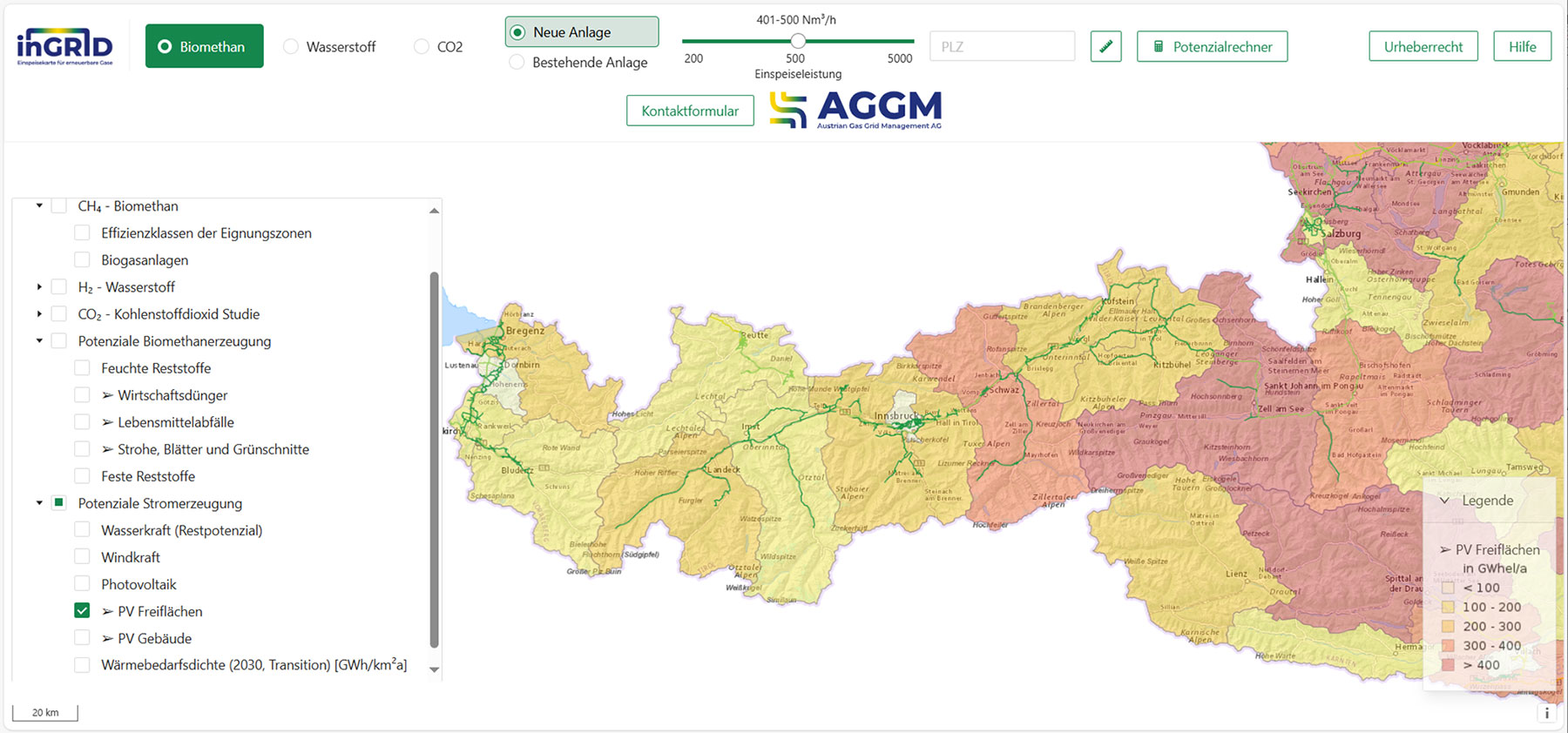
The easy-to-use Web GIS application can also be used to view the power generation potential for hydropower, wind power, and solar photovoltaics (PV) – such as the potential for PV open spaces shown here.
(Picture source: Austrian Gas Grid Management AG; basemap.at; Umweltbundesamt GmbH, Vienna)
Fichtner IT Consulting Programmed the “GIS light”
When it comes to mapping electricity, gas, or water grids, a GIS (geographic information system) is often the first choice. But such systems are mostly designed for experts. Austrian Gas Grid Management AG (AGGM), however, wanted to make its “digital twin” of the Austrian gas grid accessible to everyone, so that investors and operators could assess where it would be worthwhile to build biomethane plants. The inGRID application described in this article was intended to make selected AGGM data accessible to people without GIS skills – such as farmers and biogas specialists or those interested in investing in climate protection and green gas technology. However, there was no such map application available “off the shelf.”
Faced with this challenge, AGGM turned to Fichtner IT Consulting GmbH (FIT), a long-standing and competent partner. FIT was thus contracted to develop a “GIS light” for inGRID – a user-friendly digital map application accessible via the internet. This was a challenge that the FIT team was happy to take on, implementing the solution with a three-tier architecture based on open source software components. Since usability was very important, a flexible front end was created that shows controls, menu items, and maps differently depending on the device, display size, and display orientation. Anyone who would like to see for themselves how easy it is to use can try out inGRID at https://ingrid.aggm.at.
June 2025
Featured image: Austrian Gas Grid Management AG; basemap.at
Project website: inGRID | Injecting green Gas into the Grid

Marc Lange
Senior Project Manager in the Smart Grids Division of Fichtner IT Consulting GmbH